For many small business owners, tax planning feels like something that happens in June. In practice, the strongest results usually come from habits built across the whole year.
Good tax planning is not about chasing gimmicks or making rushed purchases at year end. It is about knowing what counts as a legitimate deduction, keeping records tidy, planning for business activity statement obligations, and setting aside cash before the ATO asks for it. When those basics are in place, tax becomes far more predictable and far less disruptive to day-to-day operations.
A practical small business tax plan usually covers:
- deductions and taxable income
- GST and BAS reporting
- PAYG withholding and PAYG instalments
- record keeping
- asset purchases and depreciation
- cash reserved for tax liabilities
What tax planning means for small business owners
Tax planning is the process of organising business finances so tax outcomes are accurate, lawful, and manageable. That includes timing income and expenses appropriately, checking which deductions can be claimed, and making sure reporting obligations are met on time.
For Australian small businesses, the biggest gains often come from the basics rather than complex structures. Clean records, disciplined cash-flow habits, and regular reviews of expenses can make a noticeable difference to taxable income and to the stress levels of the owner.
It also helps to think of tax planning as part of business planning. If a business is hiring staff, buying equipment, registering for GST, or growing fast enough to trigger PAYG instalments, the tax effects should be considered before decisions are locked in.
Business tax deductions and taxable income rules
A deduction generally reduces taxable income, which may reduce the amount of income tax payable. Australian government guidance makes the starting point fairly clear: an expense is generally deductible where it is incurred in earning business income, is not private in nature, and is supported by records.
That sounds simple, but many errors sit in the grey areas. Mixed-use expenses are a common example. If something is used partly for business and partly for private purposes, only the business portion is generally claimable. This is where good notes, invoices, and a consistent method of apportionment matter.
Small business owners should also avoid assuming that every cash outflow is deductible straight away. Some costs are immediately deductible, while others may need to be claimed over time under depreciation or other rules. Timing matters, and it can materially change the tax result for the year.
A sensible deductions check usually comes back to three questions:
- Business purpose: Was the expense incurred to earn business income?
- Private use: Is any part of the expense private or domestic?
- Records: Can the claim be backed up with invoices, receipts, contracts, or logbooks?
This is one reason separate business banking is so valuable. When personal and business spending are mixed together, tax time becomes slower, more expensive, and more open to mistakes.
Record keeping requirements for Australian small businesses
Record keeping is the engine room of sound tax planning. Without it, even valid deductions can become difficult to defend.
Digital records are now the sensible standard for most businesses. Cloud accounting software, receipt capture apps, payroll systems, and digital document storage can reduce manual work and make BAS preparation much more efficient. They also help owners see their numbers during the year rather than only after it ends.
Poor record keeping can lead to denied deductions, inaccurate BAS lodgements, penalties, and a lot of time spent reconstructing transactions. That is a high price to pay for something that can usually be improved with a better system and a simple monthly routine.
| Record type | What to keep | Why it matters for tax planning |
|---|---|---|
| Income and sales | Tax invoices, sales reports, bank deposits | Supports reported revenue and GST treatment |
| Expenses | Supplier invoices, receipts, subscriptions, rent records | Supports deduction claims |
| Bank and finance | Bank statements, loan statements, merchant fees | Helps reconcile accounts and track interest or fees |
| GST records | Tax invoices, adjustment notes, BAS working papers | Supports GST reporting on BAS |
| Payroll and contractor records | Wages, super, PAYG withholding, contractor invoices | Supports payroll compliance and year-end reporting |
| Assets and stock | Purchase documents, finance agreements, stock counts | Supports depreciation and trading stock treatment |
BAS, GST and PAYG instalments cash-flow planning
For many small businesses, the real pressure point is not the annual tax return. It is the regular reporting and payment cycle attached to the business activity statement.
A BAS may include GST, PAYG withholding, PAYG instalments, and other obligations depending on the business. If a business is registered for GST, the owner needs a reliable method for tracking GST collected on sales and GST paid on eligible purchases. If staff are employed, PAYG withholding also needs careful attention. When a business enters the PAYG instalments system, it is effectively prepaying expected tax across the year rather than facing the full amount later.
This is why tax planning and cash flow are tightly linked. Business.gov.au advises businesses to put money aside for tax in a separate bank account. That habit can change everything. It turns tax from an unpleasant surprise into a managed outgoing.
A few routines make BAS and instalment planning much easier:
- Separate tax account: transfer a set percentage of each week’s receipts
- Monthly reconciliation: match bank feeds, invoices, and payroll records
- Quarterly review: compare current profit with prior BAS estimates
- Due date tracking: diarise BAS, super, and instalment deadlines early
When a business grows quickly, cash can look stronger than it really is. GST collected is not business income to spend freely, and PAYG instalments can arrive sooner than expected. That gap between profit on paper and cash in the bank is where many businesses get caught.
Depreciation concessions and instant asset write-off timing
Asset purchases deserve careful tax planning because the timing of the claim can vary. Some assets are claimed over time under depreciation rules. Eligible small business entities may also have access to simplified depreciation rules, which can change when deductions are taken.
As at 1 July 2026, the instant asset write-off has been permanently increased to $20,000 for eligible small business entities, based on current ATO guidance. Broadly, an eligible business must be carrying on a business and have aggregated annual turnover of less than $10 million. Qualifying depreciating assets, including new and second-hand assets, may be immediately deductible if they are first used or installed ready for use in the relevant income year.
That can be valuable, but it should not drive the whole purchase decision. Buying an asset only for the tax deduction is rarely sound commercial logic. A business still pays for the asset, and the purchase should make operational sense, fit cash flow, and suit the growth plan. Before relying on the write-off, it is wise to confirm the current threshold, eligibility, and timing rules, as these settings can change.
A practical tax planning rhythm for the financial year
The most effective tax plans are not complicated. They are consistent.
A simple rhythm keeps the owner close to the numbers and gives enough time to act before year end. Waiting until the final weeks of the financial year often leads to rushed bookkeeping, unclear deduction positions, and poor purchasing decisions.
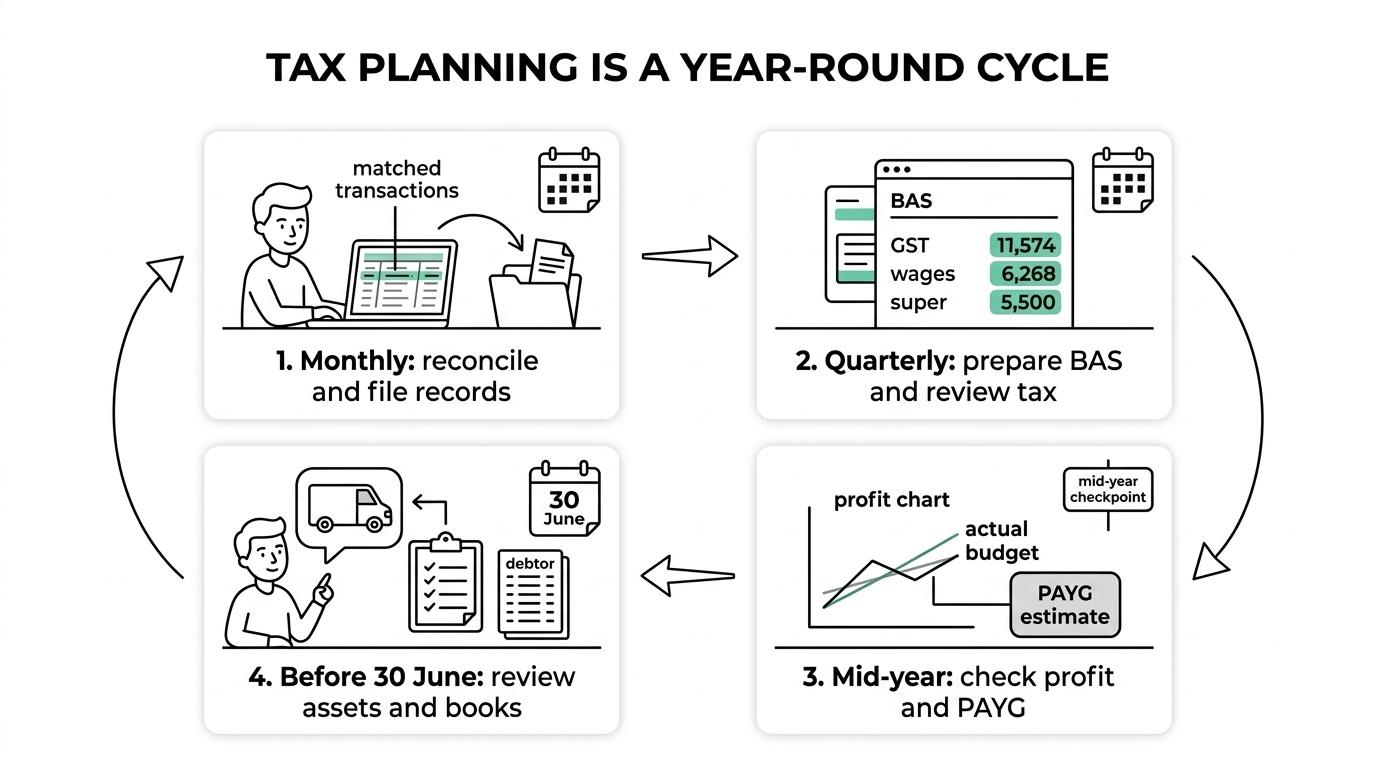
A useful pattern for many small businesses looks like this:
- Monthly: reconcile bank accounts, review profit, and file all receipts digitally.
- Quarterly: prepare BAS data, review GST, wages, super, and expected tax.
- Mid-year: check whether income is ahead of budget and whether PAYG instalments still make sense.
- Before 30 June: review asset purchases, debtor collections, stock issues, and any outstanding bookkeeping items.
This regular review cycle also helps identify broader business questions. Is the current structure still suitable? Are drawings being confused with wages? Is the business retaining enough cash to fund GST, tax, and super? Those are planning issues, not just compliance issues.
Business structure and professional tax advice for growth decisions
Tax planning basics matter for every structure, yet the details can shift depending on whether the business operates as a sole trader, company, trust, or partnership. The timing of tax, the way profits are taxed, and the reporting obligations can differ sharply. A structure that suited a start-up phase may become inefficient once turnover, staffing, or borrowing needs change.
That is where tailored advice adds value. A capable accountant can review deductions, reporting systems, payroll settings, and cash-flow habits while also looking at bigger questions around structure, financing, and growth. For small businesses across Sydney, that kind of early, clear advice often prevents expensive clean-up work later.
Tax planning works best when it is practical, timely, and grounded in accurate records. For small business owners, that usually starts with disciplined bookkeeping, sensible cash reserves, and regular reviews of BAS, deductions, and asset decisions. When those basics are handled well, tax stops being a yearly scramble and becomes part of running a healthier business.